

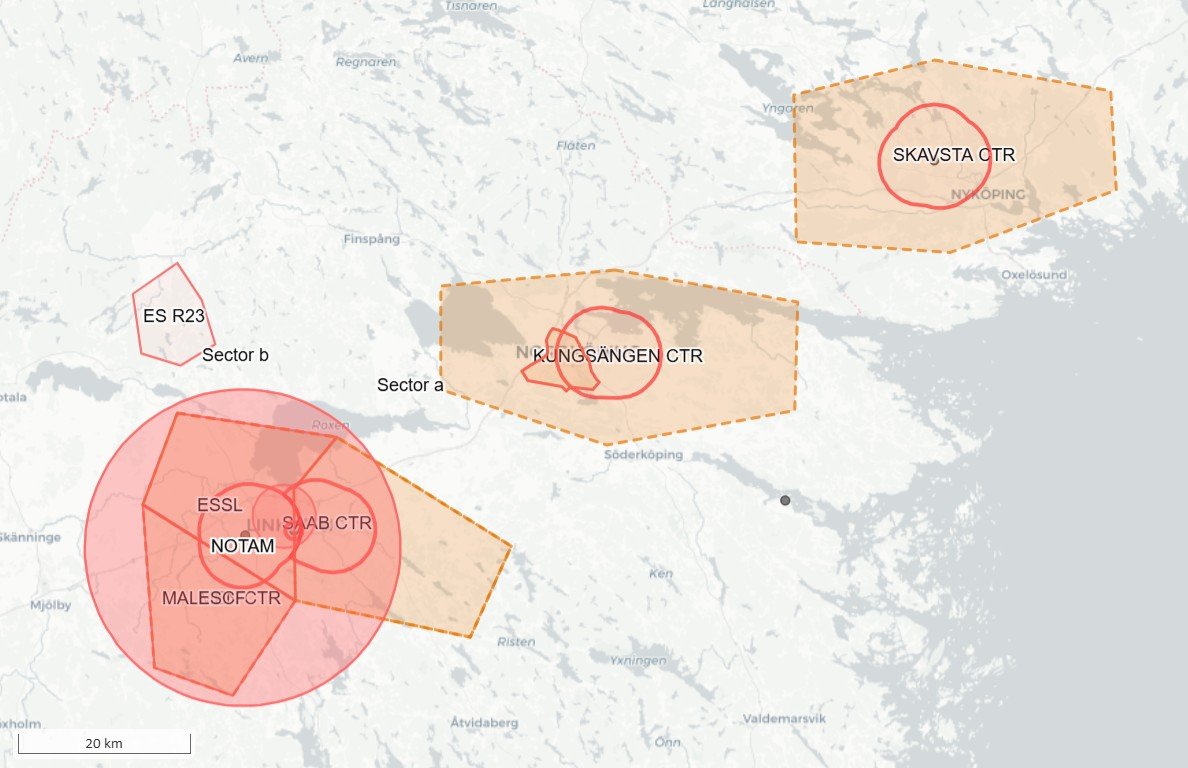
The Swedish Transport Agency (STA) has approved the establishment of a temporary D-area and associated geographical UAS zone in Norrköping, allowing the Swedish Police Authority to conduct beyond visual line of sight (BVLOS) operations with automated “drone-in-a-box” systems within controlled airspace (Norrköping CTR). This is a first-of-its-kind solution in Sweden and potentially a model that could be applied at other control zones where there is a demonstrated need for BVLOS operations before U-space becomes available.
Christoffer Massinger, State Focal Point & U-space Specialist at the Swedish Transport Agency, stated: “The decision enables police UAS operations up to 120 metres AGL and is intended to support, among other things, situational awareness, crime prevention, and incident management. What makes the case particularly interesting is the way the airspace has been designed. The D-area was developed through local coordination with airport stakeholders, ATS, and other relevant airspace users, with the aim of designing a volume that enables the operation while minimizing its impact on other aviation.”
A geographical UAS zone that correlates with the D-area has been designed to limit access to other UAS operations above 79 metres AGL, giving the Police authority an exclusive right of way between 80 and 120 metres AGL. The D-area does not exclude manned aviation; instead, specific conditions and coordination procedures are used to balance the rights and responsibilities of different airspace users and to enable coexistence.
The STA published several conditions to be applied to police drone activities within the new zone. According to the agency’s decision statement: “The Swedish Transport Agency considers that the Swedish Police Authority has demonstrated a concrete and urgent operational need to conduct BVLOS operations. The temporary D-area and the geographical UAS zone are, according to the Swedish Transport Agency’s assessment, necessary and proportionate measures to enable safe coexistence between manned and unmanned aviation.”
Massinger added: “From our perspective, D-areas are therefore an important step on the way towards U-space: we need practical solutions today, rather than waiting for the full U-space framework to be operational. The decision explicitly recognizes that temporary airspace segregation can be necessary to enable safe BVLOS operations, while also emphasizing proportionality and continued access for other airspace users.”
Key conditions include that the Swedish Police Authority must ensure the ability to communicate the status of activity through contact telephone numbers and VHF monitoring, maintain ADS-B IN receiver capability, correct altitude data, geofencing technology, and continuous flight monitoring. The police must also be able to immediately terminate activity when required for flight safety. For the geographical UAS zone, the police must administer permissions for other operators wishing to conduct UAS operations above 79 metres AGL.
