
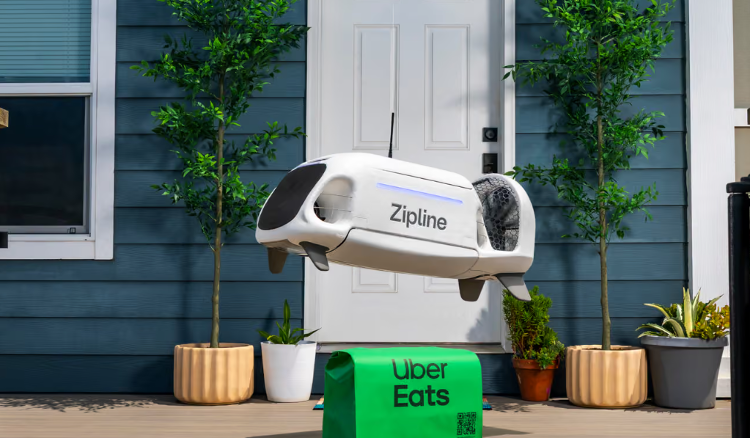
Zipline and Uber are expanding their partnership to bring large-scale drone delivery to Uber Eats, with an ambitious goal of reaching one million drone deliveries per day in the United States by the end of 2029.
The service is expected to launch in Dallas and Houston, allowing customers to choose drone delivery for eligible restaurant, grocery and retail orders. Uber is also making a strategic investment in Zipline to help accelerate the expansion of its autonomous delivery network.
The partnership will combine Zipline’s autonomous aircraft with Uber’s established delivery platform. Instead of replacing traditional delivery drivers, the companies plan to create a hybrid system in which Uber can select drones, human couriers or other delivery methods depending on factors such as distance, location and order requirements.
Zipline’s latest delivery aircraft are designed for fast urban and suburban operations. The drones can deliver packages to designated locations without landing, supporting rapid and precise drop-offs. The company has positioned the technology as a way to significantly reduce delivery times for food, groceries and other lightweight products.
The scale of the target is substantial. Zipline has already completed around one million commercial deliveries over the past year, while the new objective would require that volume to be achieved every day. Meeting the target will require major expansion of Zipline’s aircraft fleet, delivery infrastructure and operational network.
The partnership comes as the US drone industry moves toward more routine Beyond Visual Line of Sight (BVLOS) operations. Regulatory progress could enable autonomous delivery networks to operate over larger areas and at greater scale.
For Uber, drone integration could provide customers with faster delivery options while increasing flexibility across its logistics network. For Zipline, the partnership provides access to Uber’s large consumer marketplace and a potential pathway to dramatically increase drone delivery volumes.
The initiative could become a major test of whether autonomous aerial delivery can move beyond specialised applications and become a mainstream part of everyday food, retail and logistics services.
